F

The Six Days Campaign (10 February - 14 February 1814) was a final series of victories by the forces of Napoleon Bonaparte as the Sixth Coalition closed in on Paris.

With an army of only 70,000, the Emperor was faced with at least half a million Allied troops advancing in several main armies commanded by Field Marshal Prince von Blücher and

Field Marshal Prince zu Schwarzenberg amongst others.

The Six Days Campaign was fought from 10 February to 14 February during which time he inflicted four major defeats on Blücher's army in the Battle of Champaubert (above)

, the Battle of Montmirail,

the Battle of Château-Thierry,

and the Battle of Vauchamps.

Napoleon managed to inflict 17,750 casualties on Blücher's force of 120,000 with his 30,000-man army, leading later historians and enthusiasts to claim that the Six Days was the Emperor's finest campaign.

However, the Emperor's victories were not significant enough to make any changes to the overall strategic picture, and Schwarzenberg's larger army still threatened Paris, which eventually fell in late March.

Battle of Champaubert (10 February 1814) - 4,000 Russian casualties and Russian General Olsufiev taken prisoner, to approximately 200 French casualties .
- Battle of Montmirail (11 February 1814) – 4,000 Allied casualties, to 2,000 French casualties

- Battle of Château-Thierry (12 February 1814) – 1,250 Prussian, 1,500 Russian casualties and nine cannons lost, to approximately 600 French casualties

- Battle of Vauchamps (14 February 1814) – 7,000 Prussian casualties and 16 cannons lost, to approximately 600 French casualties
Napoleon headed southward towards Seine River

where the main Austrian Army under Karl Philipp, Prince of Schwarzenberg, was threatening Paris from the southeast. Napoleon stopped the advance on Paris at Mormant (about 30 miles from Paris) on 17 February, some French units had to march 60 miles in 36 hours to reach Mormant.

This action, plus defeats suffered by the Prussians to the north, caused the Prince of Schwarzenberg

to order a retreat. Schwarzenberg left Frederick I of Württemberg

, to command a rearguard at the key village of Montereau,

which was located at the confluence of the Rivers Seine and Yonne.

Napoleon ordered Marshal Claude Victor-Perrin, duc de Belluno, to Montereau,

but Victor's force was slow in marching on Montereau, this gave time for Württemberg to strengthen his hasty positions. Harassing Cavalry attacks by General Claude Pierre Pajol,

managed to push back outposts and slow the improvements of the defenses, but could do little else without the support of the infantry troops of General Victor-Perrin.
At 9:00 AM on the 18th Victor arrived at Montereau. Furious with Victor’s slow advance, Napoleon replaced him with Étienne Maurice Gérard.

Gérard set to work establishing fire superiority over Württemberg’s defending troops. By early afternoon artillery of the Imperial Guard had arrived and allowed Gérard to silence Württemberg’s batteries and bombard the village.

At 3:00PM a French attack captured a ridge forming the key to Montereau’s defences. Frederick I of Württemberg subsequently ordered a retreat, but it was soon turned into a rout by a cavalry forces led by Claude Pierre Pajol

leading a sweep into the village and Allied rear. Pajol’s cavalry charge also prevented the Allies from detonating demolition charges on two key bridges allowing further pursuit.

The Allies suffered 6,000 casualties and lost 15 cannons, the French suffered 2,500 casualties.The army of Frederick I of Württemberg

was in full retreat and that of Karl Philipp, Prince of Schwarzenberg fled eastwards towards Troyes in disarray.


 the Battle of Château-Thierry,
 and the Battle of Vauchamps.
 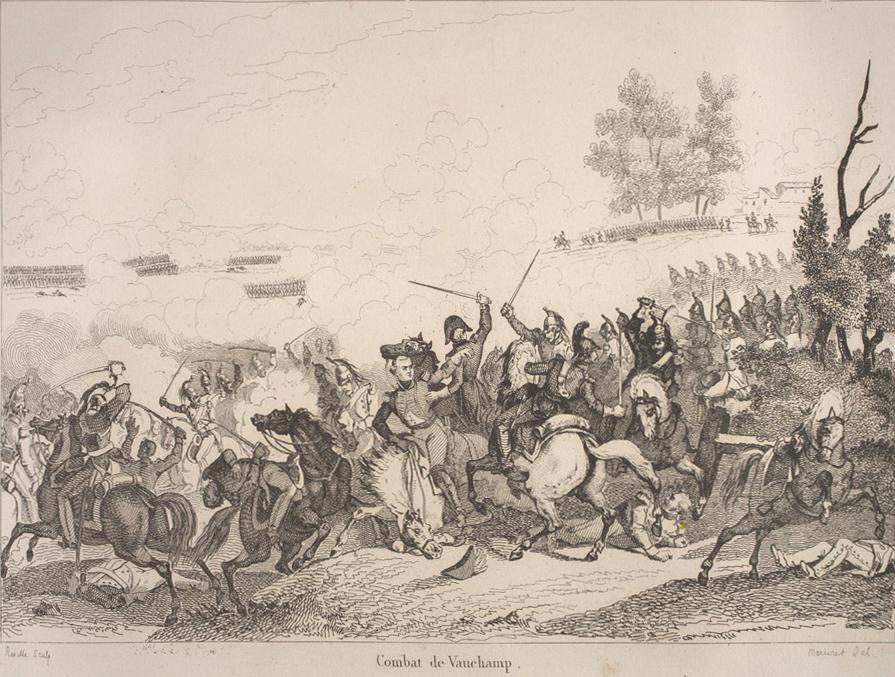 Napoleon managed to inflict 17,750 casualties on Blücher's force of 120,000 with his 30,000-man army, leading later historians and enthusiasts to claim that the Six Days was the Emperor's finest campaign.


 THE BATTLE OF AUSTERLITZ


